Showing posts with label Japanese food. Show all posts

Thursday, January 31, 2013

Niku dango (Japanese meatballs)

We make niku dango every couple of weeks. It's a beFOODled favourite and a family recipe. The meatballs are made from minced pork and made even more delicious by cooking in a sweet and sticky soy sauce. They are perfect over rice. Sometimes I add a layer of spinach or arugula in between the rice and meatballs to sneak in some veggies. Lately I've been making extra rice so that we can have fried rice the next day.

Niku Dango (Japanese meatballs)

Meatballs
500 g ground pork
one onion, minced
one inch piece of ginger, minced
4 shiitake mushrooms, finely chopped
1 Tbsp sugar
1/3 cup panko breadcrumbs (optional)
1 tsp dijon mustard (optional)
salt and pepper
olive oil for frying

Sauce
5 Tbsp each of sugar, soy sauce and rice wine vinegar.
water
a little cornstarch for thickening

In a bowl, combine the meatball ingredients: pork, onion, ginger, mushrooms, sugar (and breadcrumbs and mustard, if using) and salt and pepper. Gently combine the ingredients using a fork. Form into two-inch meatballs.

In a large wide-bottomed frying pan or Dutch oven, heat some olive oil on medium heat. Add all of the meatballs, turning several times to brown the outsides on two or three sides.

Meanwhile, combine all the ingredients for the sauce in a pitcher and stir. Add enough water to make the sauce up to two cups.

When the meatballs have browned on three sides, pour all of the sauce into the pan. Stir to coat all the meatballs. Bring to a boil, then cover the pan and lower the heat to simmer for five-10 minutes or until the sauce thickens.

Serve five meatballs with a little sauce on top of rice with chopped green onions for garnish. You'll have lots of leftovers for lunch the next day.

Saturday, August 21, 2010

Spaghetti and meatballs, Japanese style


Put your hand up if you love meatballs! This is spaghetti and meatballs, Japanese style, a great recipe adapted from one of my favourite cookbooks, Jane Lawson's Yoshoku. I use my usual spaghetti and meatball recipe and add the Japanese ingredients that she recommends: sake, dashi, mirin, soy sauce and panko (crunchy Japanese breadcrumbs). I would recommend chicken instead of pork or beef for the meat in the meatballs; the comparatively mild flavour of chicken is a nice canvas for showing off all of the great Japanese flavours.

Chicken meatballs in a gingery tomato sauce
serves two with leftovers

Meatballs

1 package (~500 g) ground chicken
1 onion, finely diced
1 garlic clove, finely minced
1 egg
1 tsp Dijon mustard
1 cup panko breadcrumbs (or whatever kind you have on hand)
salt and pepper
2 Tbsp sake
2 Tbsp soy sauce
1-inch piece of ginger, grated (optional)
A handful of finely chopped fresh parsley (optional)
oil for frying

Tomato sauce

1 onion, finely chopped
1 clove garlic, finely minced
a sprinkling of red pepper flakes
1 tsp dried thyme
1- or 2-inch piece of ginger, grated
1/4 cup mirin (a sweet Japanese cooking wine)
1 14 oz. can of chopped tomatoes
1 tbsp tomato paste
1/4 tsp dashi granules
1 1/2 tsp soy sauce
1/2 tsp sugar
2 green onions, finely sliced for garnish

Noodles
2 handfuls of Japanese udon or soba noodles, each handful about the diameter of a quarter each, freshly cooked

To make the meatballs, put all of the meatball ingredients in large mixing bowl, and mix together with clean hands to combine. Cover the bowl with saran wrap and put it the bowl in the fridge until ready to cook.

To make the sauce, heat some oil in the bottom of a large, high-sided saucepan. Fry the onion for five minutes until softened and glassy, then add the garlic, red pepper flakes, thyme and ginger, and saute for one minute but do not let the garlic burn.

Add the tomato paste, chopped tomatoes, mirin, dashi, soy sauce and sugar, and half a cup of cold water. Increase the heat and let come to a boil. Simmer for half an hour or until reduced and slightly thickened.

While the sauce is thickening, put on the water for the udon noodles. Form the meatball mixture into small tablespoon-sized meatballs and brown them in batches in a thin layer of hot oil in a frying pan, about five minutes per batch. Turn the meatballs two or three times until they are nicely browned.

Add the meatballs to the simmering sauce and let the two cook together a few minutes while you cook and drain the udon noodles.

Serve the meatballs and sauce on top of the noodles and garnish with finely chopped green onions.

Thursday, August 5, 2010

Ootoro, the tenderest of sushis


Visit beFOODled on Flickr.

If you love tender meats like pork belly, foie gras or duck confit, then you will also fall in love with ootoro, the most melting cut of sushi there is. We ate it for the first time in Hawaii at Sansei restaurant.

Ootoro means "extreme toro" according to S's dad who is Japanese, and from what I can tell this name is a reference to its extreme tenderness. The further down the body of a fish you go, the tenderer and more expensive the cut. Ootoro is taken from the underside of the tuna's belly where there is so much marbling of fat that it literally melts in your mouth.

You can see from the picture that ootoro is very pink, much more so than maguro, a more common cut of tuna found on sushi menus everywhere. Again this is related to the fat content. Maguro is much redder because it is from a much leaner body part, the side of the tuna.

At $17 for a two-piece portion, eating ootoro was a costly education ... but it was a delicious one, too, and so worth it if you love sushi!

Saturday, July 31, 2010

Miso butterfish at Sansei, a Japanese restaurant in Hawaii


Visit beFOODled on Flickr.

There is so much local seafood in Hawaii, I really wanted to find a wonderful Japanese restaurant, as no one does fish like they do! After much searching in my guidebook, I found one called Sansei Seafood Restaurant and Sushi Bar, and we enjoyed it so much that we ate there twice in one week. Both times we got a table on the balcony, which overlooked the ocean, and ordered the Matsuhisa-style miso butterfish, a very tender fish marinated and seared in sake and sweet miso. It was my favourite dish at the restaurant and I would love to try to recreate it. It's the signature dish of Nobu Matsuhisa, a celebrity chef who is in business with Robert De Niro, although the chef and owner of Sansei is D.K. Kodama, who owns several restaurants in Hawaii.

We also ordered the Japanese calamari salad (below), a crispy wonton basket filled with fried calamari that is served over a bed of greens from Nalo, a local lettuce and salad-greens farm in Oahu. And we also tried something else, something very special that rivaled the tastiness of the butterfish and as such, deserves its own blog post, coming soon ...


Visit beFOODled on Flickr.

Sansei Seafood Restaurant & Sushi Bar
Waikiki Beach Marriot Resort and Spa
2552 Kalakaua Avenue
Honolulu, Hawaii
808.931.6286


View Larger Map

Monday, April 12, 2010

Return to Ematei in Toronto


S and I went to Toronto this weekend and revisited Ematei, a Japanese restaurant just a few steps north of Queen West near the Eaton Centre. We discovered it three years ago and really enjoyed it. I'm happy to say it's still delicious.

My favourite tastes on this occasion came from our uni (sea urchin) and saba sushi pictured above. Uni tastes exactly like the salty seaside. A few years ago I found it too marinelike and seaweedish in flavour, but now I love it. And the delicious vinegary saba, simply my favourite sushi of all time, was so good I ate it with my eyes closed to get the full savoury experience (I think S was smirking but I didn't care ;)

We also ordered an interesting appetizer called enoki foil. It's a handful of enoki mushrooms, a strip of fake crab and some caramelized onions, all wrapped in foil and baked in the oven. It was very tasty and obviously a good way to cook enoki, which I have previously only eaten in soups.

Ematei
30 St. Patrick St. (corner Queen)
Toronto, ON
416.340.0472

Friday, March 12, 2010

Gyoza

Gyoza, Japanese dumplings
Visit beFOODled on Flickr.

Gyoza are one of S's favourite foods from childhood. They are little Japanese dumplings made from ground pork, Napa cabbage and ginger, and then pan-fried and steamed. S and I always make them together because they are really a two-person job. We make a few panfuls and eat as much as we can as a main meal. This is his mother's recipe, and it's very delicious.

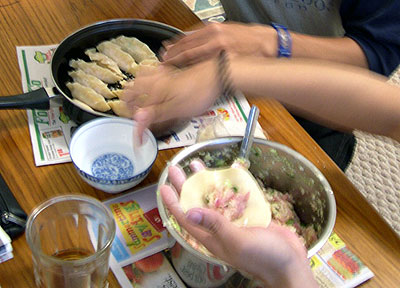
Gyoza, Japanese dumplings, howto
The gyoza assembly line.

Gyoza
Printable version

Prep time: 30 to 40 minutes
Cooking time: about 25 minutes per panful
Serves six to eight people as a side or three to four as a main.

Filling
350 g ground pork
1 onion, medium-sized and diced
a hunk of ginger, finely minced (as you would garlic)
8 large leaves of Napa cabbage (hakusai in Japanese), thinly sliced
6 mushrooms, minced, preferably shiitake
1 egg
1 Tbsp sugar
a couple of pinches of salt

Wrappers
gyoza wrappers (preferably pre-floured, Double Happiness brand is good)
bowl of water
1 human finger!

Dipping sauce
1 part soy sauce
1 part rice vineagar
a few drops of La-Yu oil (a kind of hot sesame oil with chillis)

Mix all ingredients for the filling together in a big bowl.

You need gyoza wrappers from a Japanese or Korean market. Double Happiness is one of many brands you might find. Gyoza wrappers are small and round, they're about the width of your palm. Lay out 12 wrappers on a cutting board. Scoop a tablespoon or so of the mixture in the centre of each wrapper. The exact amount you find easy to work with may take a bit of trial and error.

This next part takes practice! This is the difficult part. Dip your one human finger in the water and wet a ring around the edge of the wrapper. Timing is important. Do about six wrappers at once. Now dry your finger. Next, fold each wrapper in half, pressing the wet edges together. Lay the closed gyozas aside on a plate with the seams facing up. Finish making your gyoza until you have enough to fill the frying pan you will be using, as shown in this Wikipedia photo.

The hard part is getting the right amount of water on the wrapper. You want the wetness to be just right when you fold it together. If it's too wet, it'll stick to your fingers and fall apart. If it's too dry, it won't stick to anything at all.

Put some vegetable oil in your frying pan and turn up the heat to medium. When the pan is hot, start putting in the gyozas by hand. Drag each gyoza in the oil to coat both sides as you place them. This will keep them from sticking together. Continue until you fill the pan. Then pour about one centimetre of water into the bottom of the pan. Put the lid on and let them cook 15 to 20 minutes. After 20 minutes, take off the lid but keep the heat on. Now you want them to dry out and brown on the bottom, about 5 minutes or until they turn golden brown.

As the first panful is cooking, make the dipping sauce and prep the second batch of gyozas. You can refrigerate the filling for one day and make the rest tomorrow, but don't freeze it.

When the gyozas have browned nicely, let them cool a bit, slide them all out onto a big serving plate, and serve with the dipping sauce.

Gyoza, Japanese dumplings, howto
Little gyozas waiting for their steam treatment.

Monday, March 8, 2010

Salmon sushi


Visit beFOODled on Flickr.

We made lovely sushi at home for our Valentine's Day seafood dinner. Big thick slices of salmon on nice pudgy rice balls! They turned out so well. The salmon was from Pelican Grill and tasted very buttery.

S found a sushi rice recipe online: we made rice in the rice cooker and then mixed in some water, sugar, salt and rice wine vinegar. We also put a little strip of wasabi on the top of the rice ball before laying down the salmon.

Sunday, March 7, 2010

Angry hakusai


Visit beFOODled on Flickr.

This hakusai (Napa cabbage) was waiting to be made into gyoza, but we didn't get around to it for three weeks. Now he's angry hakusai because we bought a fresh one for our gyoza night!

(Stay tuned for the recipe coming soon.)

Thursday, March 4, 2010

Edamame infused with Asian spices


Visit beFOODled on Flickr.

Although I love to eat edamame plain, this is also a really nice way to make it. The secret is lots and lots of ginger. I keep a piece of ginger root in my freezer and just grate it from frozen.

I combined a few cups of water with about an inch of grated ginger and its juice, a couple of star anise (you could also use fennel seeds or toss in some fresh fennel pieces), a teaspoon of soy sauce, a splash of mirin and a few drops of chili sesame oil. When the water boiled, I added a package of frozen edamame still in the pod and simmered them for 10 minutes and then drained and salted them. You're not supposed to eat the pods, just suck on them and squeeze them in your mouth until they break, and then eat the soybeans inside. So gingery and so good!

Friday, January 29, 2010

Em's sushi party


Visit beFOODled on Flickr.

Have you ever seen a more charming sushi set than the little cloud and soy-sauce bird above? It belongs to Em, and this is how we celebrated our sushi night with friends.

Em organized a sushi- and salad-roll-making night at M and DV's house. Everybody brought different fixings and we all took turns making rolls. There were sweet potatoes, cucumbers and all kinds of wonderful fillings. For fish, we had salmon, tuna and shrimp. There's nothing better than making food together with friends, and then having a giant feast at the end of the night!


Visit beFOODled on Flickr.

Em also served pieces of the roasted nori in a little bowl all on their own. Usually I only use nori in sushi making, but they have a nice seasidey, salty and crunchy taste on their own. Thanks for introducing me to another great snack!


Visit beFOODled on Flickr.

Sunday, October 18, 2009

Ebisu on Robson

I was in Vancouver this week, where there are delicious Japanese restaurants galore! A friend introduced me to a trendy Japanese place on Robson called Ebisu that is now on my "To Visit" list the next time I return to this fair city.

I loved it! Ebisu is among a growing number of restaurants that is infusing a new vibrancy into Japanese food. It's taking traditional dishes and marketing them as tapas plates with a twist. Hapa Izakaya, where S and I ate two years ago, is another good example of this new kind of Japanese restaurant that draws a younger crowd because of its unique interpretations.

Some of the dishes were a fusion of cuisines — we ordered salmon carpaccio (an Italian term for thin shavings of raw meat), which came drizzled in a citrus white-wine mayo. It was a fresh take on the traditional tataki (which longtime readers of beFOODled will know I also adore) that consists of thinly sliced raw or lightly cooked beef in a citrus vinaigrette.

We ordered five dishes — saba (mackerel) flame, saba inferno, salmon carpaccio and the B.C. and mega dynamite rolls — and a pitcher of delicious sangria to wash it all down. Five dishes might not seem like a lot for two people, but we were full!

My favourite was the saba flame. This dish is also a great example of what I mean by how these restaurants are funkifying the traditional. Saba flame is mackerel sashimi but the server lights it on fire with a hand-held blow torch at your table. She did the same thing with the saba inferno, searing the mackerel skin. It gave it a truly mouthwatering, coal-fired flavour.

The food is fresh and has so much flavour. I would recommend Ebisu if you happen to be on Robson Street looking for great Japanese food.

Ebisu on Robson
827 Bute Street
Vancouver, B.C.
Canada
604.689.8266 (reservations are recommended)


View Larger Map

Tuesday, September 29, 2009

Sushi rolls at Em's


Visit beFOODled on Flickr.

Last Thursday, Em hosted a girls night and we all helped her make sushi rolls. She bought fresh, sushi-grade fish from Pelican Grill, a fish market with a restaurant attached. She bought a pound and a half of salmon for $20, plus some tuna for $12 and smoked salmon chunks for $6. We mixed and matched the fish with some cooked shrimp cut in half, and cucumber and avocado. We also ate edamame (beautiful, boiled soybeans) and longan fruit, which I had never had before, but have a lychee-like flavour and texture. They are so yummy and juicy, and have a big, shiny, dark-purple pit inside.


Visit beFOODled on Flickr.

I brought instant miso soup, but forgot to make it in all of the excitement!


Visit beFOODled on Flickr.

Of course, girls nights are not complete without animal companions. I leave you tonight with a picture of the beautiful Hermes, an adorable Himalayan who had me at meow. Hermes is very old and likes to have his face smushed, but only by girls :) Good thing there were five of us on hand to oblige!


Visit beFOODled on Flickr.

Pelican Fishery and Grill
1500 Bank Street
Ottawa, ON
613.526.0995


View Larger Map

Sunday, September 20, 2009

Sho-dan, a Japanese restaurant in Montreal


Visit beFOODled on Flickr.

Until this year, my Japanese food destinations in Montreal were Sakura and Katsura, adjacent restaurants on rue de la Montagne. Unfortunately, Katsura has since disappeared and Sakura is just not what it used to be.

So after a bit of online research, a lot of positive reviews led S and I to Sho-dan, a Japanese restaurant on Metcalfe. Le Chef, a francophone magazine that covers food news in Quebec, honours restaurants in Quebec every year with an awards show, and Sho-dan won the gold award in 2009 and the silver in 2008 for Best Sushi.

I was excited to go and, as it turns out, I loved the space and the decor, and the service was very good, too, but the food ... well, I'll get to that in a minute.

The restaurant is beautifully decorated. It has nice mood lighting and there are dramatic flower arrangements. It's very modern, and obviously a favourite place of many Montrealers because it was packed.

Sushi is the focus of Sho-dan's menu. There must be at least 70 kinds of sushi, sashimi and rolls to choose from. The selection ranges from the traditional to the cool and creative with names like Mango Tango and Dancing Dragon. The rest of the menu is appetizers, salads, tempura and teriyaki.

We ordered lots of sushi, about seven or eight kinds. I realize that this is supposed to be award-winning sushi, so I'm treading carefully as I write this, but we were disappointed when our big plate arrived. The fish was tasty enough, but the sushis were small and thin, more like slender fingers than pudgy ovals with thick slabs of fish floating on top (like I've had in Ottawa and Calgary). Also, the rice was a bit mushy. I wish we had been able to show you with some photos, but the lighting was so dark that none of them turned out.

Including tax and tip, our meal of three appetizers, seven or eight sushis and a couple of drinks came to about $100.

I'd be willing to go back and give Sho-dan another try, but the truth is I don't recommend it since I know sushi can be much better than this. And I'm still searching for a great Japanese restaurant in Montreal.

Does anyone have any suggestions?

Sho-dan
2020 Metcalfe
Montréal, Que.
514.987.9987


View Larger Map

Tuesday, January 13, 2009

Shikiji, a ramen house in Calgary


Miso ramen at Shikiji on beFOODled's Flickr page.

There's one thing that puts the ramen at Shikiji in a league of its own: You get a facial while you eat!

Ramen here is served in a bowl that's honestly at least 10 inches wide. Every time I leaned over to slurp up a noodle or hunt for a slice of BBQ pork, I got a steamy miso facial treatment. I could have literally dove in and swam around, like Rool, the brownie in Willow who falls into a barrel of beer and can't believe his good fortune :)

There are four ramen choices on the menu: soy, miso, BBQ pork and shio. The difference, I think, is mostly in the broth. My bowl, which must have held several litres of miso ramen, cost a mere $11.60. The first thing the server brings is a little mortar filled with sesame seeds and a pestle for grinding them up. You can grind the seeds while you wait, and then sprinkle them over your soup. The only thing missing was a boiled egg.

How I wish Shikiji was in Ottawa, but alas, it's a little gem that belongs to Calgary. It's one of the many places that makes this city sparkle with a great but still largely unacknowledged culture.

Aside from the delicious noodles, there's a full menu of every Japanese favourite you could imagine, from edamame and gyoza to donburi and sushi. Below is a photo of the bento box that S's mom ordered.

Shikiji Japanese Noodles and Sushi
1608 Centre St. N.E.
Calgary, AB T2E 2R9
Tel: 403.520.0093
www.shikiji.ca


Bento box at Shikiji on beFOODled's Flickr page.

Monday, December 29, 2008

Ichibei, a Japanese restaurant in Ottawa

Ichibei, a Japanese restaurant in OttawaIchibei, a Japanese restaurant in Ottawa, originally uploaded by beFOODled.

I recently wrote about my favourite Japanese restaurant in Ottawa for Foodtv.ca. I also reviewed it earlier this year on beFOODled. I bet you're curious about the identity of that cute little animal in all of the pictures, the one with a bellyful of sake! Either post will tell you about him, so click on to find out more.

Friday, August 8, 2008

Chilled Shrimp, Cucumber and Noodle Salad

Japanese shrimp, cucumber and noodle saladJapanese shrimp, cucumber and noodle salad, originally uploaded by beFOODled.

This noodle salad is another recipe from my favourite Japanese cookbook. I made it earlier this week for dinner. It's really light and refreshing, and the dressing tastes fantastic. If you keep a big bag of shrimp in the freezer and some classic Japanese pantry ingredients on hand (like those needed for this dressing), then you just have to remember to buy cucumbers and green onions to make this.

Chilled Prawn, Cucumber and Noodle Salad
serves two
recipe adapted from Jane Lawson's Yoshoku

12 cooked large shrimp, peeled
2 Lebanese (short) cucumbers
1 Tbsp dried wakame pieces (a kind of seaweed)
2 handfuls of somen noodles, each the diameter of a quarter
3 spring onions, thinly sliced on the diagonal
Japanese seven-spice mix (togarashi)

Dressing:
1/2 tsp dashi granules (a stock made from fish and seaweed)
1 Tbsp hot water
1/2 cup rice vinegar
1/4 cup mirin
1 tsp soy sauce
1 tsp sugar
a dollop of a sesame-based dressing like Wafu (or sesame oil)
2 tsp grated ginger and its juice (optional)

Cut the shrimp in half lengthways and set aside in the fridge. Halve the cucumbers, scrape the seeds out with a spoon, and slice into thin half moons. Put in a colander in the sink and sprinkle over with salt. Let rest for 10 minutes, then rinse and squeeze out the water. Set aside in the fridge. Soak the wakame in a cup of water until they have expanded, about five minutes. Drain and chill.

Make the dressing by dissolving the dashi in the hot water in the bottom of a big mixing bowl. Add the rest of the liquids and stir to combine.

Cook the somen noodles by dropping them into a pot of boiling water for two minutes. Drain and cool the noodles in a colander under cold running tap water.

Mix all the ingredients together in the dressing and save some spring onion for garnish. Serve cold with a sprinkling of seven-spice mix.

Tuesday, June 10, 2008

Totoya - Ottawa's No. 1 ramen


Totoya is Ottawa's No. 1 ramen, but I must add it's also the only source of ramen in the whole city. Regulars of beFOODled will know how much I love ramen and won't be surprised that I consider this dearth a strike against Ottawa's restaurant scene.

But back to Totoya. It's a very nice, clean place. The wait staff are very friendly. My favourite dish is the ramen, which is very good. S and I order it at lunch because unfortunately it's not always on the dinner menu. You also have to go before 2 p.m. because the restaurant closes then and re-opens at 5 p.m. for dinner.

We have also been here before for Totoya's all-you-can-eat sushi evening with Squeaky, Calimocho, MV and DV (aka the Christmas elf for all you former CWFers). This special night happens very infrequently, but for $26.95 you are constantly offered platefuls of sumptuous rolls. I discovered spicy salmon and salmon-skin here, although tuna and BBQ eel are still my favourites :).

Calimocho also introduced us all to the pleasure of drinking cold beer and sake at the same time this evening ;) Totoya offers a cold, cloudy sake that's very good with beer, and oddly enough, made in Calimocho's home state of California.

Totoya
297 Dalhousie Street
Ottawa, ON K1N 7E5
613.241.2224

Thursday, January 31, 2008

Ichibei — the best Japanese restaurant in Ottawa


Ichibei is my favourite Japanese restaurant in Ottawa. I get so excited! It's one of the first places S and I went to together, and where I discovered that Japanese food went far beyond sushi and tempura. Clockwise from the top is our recent meal of sukiyaki, Japanese pickles (eggplant, cucumber and daikon), sushi and an appetizer of tuna and natto (fermented soy beans that I'm slowly developing a taste for).

Ichibei has extremely tasty food and a well-balanced menu. The agedashi dofu and beef tataki pass my "favourite Japanese appetizers test" with flying colours. There's also a harusame salad appetizer that I just can't get enough of. If only I knew the recipe! I've tried to ask but understandably they won't tell me. From what I can tell it has bean thread (harusame) noodles, julienned carrots, crab meat, possibly cucumber and egg, and a spicy mayonnaise dressing that's so light and refreshing.

It's a tiny restaurant, but tastefully decorated. The tanukis (Japanese raccoons) in which they serve sake are just too cute. We always ask for one. You have probably noticed that our tanuki is posing with every dish in the photos :).

My friends at Ottawa Foodies have also noted that Ichibei is the place where the Japanese Embassy takes its guests from Japan, which suggests the food is quite authentic!

The only things I don't like are the small sushi portions, which is unfortunately the norm in Ottawa. The sashimi plate in particular has ridiculously tiny pieces for a price tag close to $25. This especially disappoints S, who spent many years in Vancouver where the portions are more than a mouthful to say the least.

We usually order a medium bottle of sake, two miso soups, two à la carte appetizers, a hot bowl food like sukiyaki or don buri and four pieces of sushi. It comes to about $100 for two people.

Ichibei
197 Bank Street, corner Gloucester
Ottawa, ON
613.563.2375

Sunday, January 6, 2008

Sushi Rolls


People often give my Dad sushi sets. He has at least three that I know of. He is well-known among his friends and colleagues for a love of food and all things Japanese, so naturally, sushi sets are a popular gift to him.

We cracked one open over Christmas and I showed him how to make sushi rolls the way my friend Jay showed me in Montreal. This recipe uses canned fish and other western ingredients, so it's not very traditional, but it's very good. You can find the Japanese ingredients at SuperStore or any Asian grocery store.


Sushi Rolls


For the sushi rice:
1 C short-grain rice
2 Tbsp rice vinegar
1 Tbsp sugar
1 tsp salt

For the rolls:
4 sheets of roasted nori (the seaweed wrapping)
1 small can of salmon or tuna, mixed with some mayonnaise
half a cucumber
1 roasted red pepper
1 hard-boiled egg
mayonnaise
wasabi paste
soy sauce for serving
pickled ginger for serving

Wash the rice until the water runs clear (about four times). Cook the rice according to package instructions. Remove from the element, cover with a tea towel and let rest for about 10 minutes. After 10 minutes, stir in the vinegar, sugar and salt, gently so the grains stay intact. Let the rice cool to room temperature. (We made ours the night before and kept it in the fridge.)

Put some water and a little bit of vinegar in a bowl. Dip your fingers in this bowl to prevent the rice from sticking to them while you are assembling the sushi. Peel the cucumber. Slice the cucumber, egg and roasted red pepper into matchstick pieces.

Lay out a piece of nori with the shiny side down. Spread a small stripe of wasabi across the sheet about 1/4 of the way up - this is approximately where you'll place the fillings. Spread the rice over 2/3 of the nori sheet as shown in the photo above, pressing it into place with a fork or spoon. Spread a small stripe of mayonnaise where you are going to place the filling. Spread some salmon over top, and then build the layers of cucumber, egg and roasted red pepper over top of that.

Dip your fingers in water and dab the top and side edges of the nori sheet so that the roll will seal when you roll it up. Roll the nori up firmly. I just use my hands, but you can use a bamboo mat as a guide if you want.

If you have time, you can put the rolls in the fridge to firm up a bit. This makes cutting cleaner. Or you can cut the roll right away. Cut into about one-inch rounds and discard the end bits. Serve it up with soy sauce and pickled ginger.

Friday, October 26, 2007

The Gastronati Do Japan!


Our latest meal was a Japanese extravaganza! As you can see from the montage, there was no shortage of sushi or other delectable delights. Peanut Butter and Jelly made the sushi - they even made my personal favourites - unagi (BBQ eel) and saba (mackerel). Squeaky and Calimocho brought the pickled carrots, and spicy eggplant and ginger-beef dishes. I made the yakitori skewers that I've blogged about before. This time I used enoki and shiitake mushrooms, leeks, green onion pieces and bacon. And S made gyoza from scratch! Gyoza is ground pork, hakusai (Japanese cabbage), ginger and onion in a light rice wrapper and pan-fried. It's really time-consuming, but for a special occasion it's worth it!

Gyoza
Prep time: 30 to 40 minutes
Cooking time: about 25 minutes per panful

Serves six to eight people as a side or three to four as a main.

For filling:
350 g ground pork
1 onion, medium-sized and diced
a hunk of ginger, minced
8 large leaves of hakusai, thinly sliced
6 mushrooms, minced, preferably shiitake
1 egg
1 Tbsp sugar
a couple of pinches of salt

For wrappers:
gyoza wrappers
bowl of water and
1 human finger!

For dipping sauce:
1 part soy sauce
1 part rice vineagar
a few drops of La-Yu oil (a kind of hot sesame oil with chilis)

Mix all ingredients for the filling together in a big bowl.

You need gyoza wrappers from a Japanese or Korean market. Double Happiness is one of many brands you might find. Gyoza wrappers are small and round, they're about the width of your palm. Lay out 12 wrappers on a cutting board. Scoop a tablespoon or so of the mixture in the centre of each wrapper. The exact amount you find easy to work with may take a bit of trial and error.

This next part takes practice! This is the difficult part. Dip your one human finger in the water and wet a ring around the edge of the wrapper. Timing is important. Do about six wrappers at once. Now dry your finger. Next, fold each wrapper in half, pressing the wet edges together. Lay the closed gyozas aside on a plate with the seams facing up. Finish making your gyoza until you have enough to fill the frying pan you will be using, as shown in this Wikipedia photo.

The hard part is getting the right amount of water on the wrapper. You want the wetness to be just right when you fold it together. If it's too wet, it'll stick to your fingers and fall apart. If it's too dry, it won't stick to anything at all.

Put some vegetable oil in your frying pan and turn up the heat to medium. When the pan is hot, start putting in the gyozas by hand. Drag each gyoza in the oil to coat both sides as you place them. This will keep them from sticking together. Continue until you fill the pan. Then pour about one centimetre of water into the bottom of the pan. Put the lid on and let them cook 15 to 20 minutes. After 20 minutes, take off the lid but keep the heat on. Now you want them to dry out and brown on the bottom, about 5 minutes or until they turn golden brown.

As the first panful is cooking, make the dipping sauce and prep the second batch of gyozas. You can refrigerate the filling for one day and make the rest tomorrow, but don't freeze it.

When the gyozas have browned nicely, let them cool a bit, slide them all out onto a big serving plate, and serve with the dipping sauce.

Related Posts with Thumbnails